Selasa, 22 Oktober 2013

Unclear Gender/Sex? Is My Chicken an Hermaphrodite? The Story of the Gynandromorph Chicken

She looked like a pullet... up until she didn't look like a pullet. But now she doesn't quite look like a rooster, either. What is going on?? At first this chicken's gender was very unclear!


Scientists believe that Gynandromorphism in chickens happens when two sperm fertilize the same egg. It is somewhat rare, happening in 1 of every 10,000 chickens. If you meet enough chicken people, sooner or later you will hear tales of a chicken of questionable sex. And as it so happens, you are currently reading a story on a blog of someone who has a Chicken Of Questionable Sex... so we'll just call this chicken "Coques" for now.


Meet Coques:


Showing his/her girly side. No - I mean really. This just may be the female side of the bird!

As of the writing of this article, Coques is about 23 weeks old. As you can see, s/he has no noticeable saddle feathers. If you look closely, you can see that the tail feathers on this side are rounded, set at an angle and quite pulletish. But look at the tips of the tail feathers you can just make out on the other side... they are sickle feathers!


Can you see the difference?

I knew there was something different about this bird from early in his/her chickhood, but at that time I just thought him/her to be a special needs chick, and that perhaps it had experienced incubation issues and lack of proper nutrition with it's original owner (who fed it low-protein layer feed for it's first couple months of life).

One of the first things I noticed was that s/he was lopsided. Yes - the tail goes to one side, as does the neck, and it runs in the goofiest, klutziest manner I've ever seen.

 Yes - the tail always leans to the left... probably because of the different kinds of feathers coming in on each side.

 Here is where you can actually see a color difference between the two halves of this bird. This difference would be much more pronounced in unmottled breeds where the roosters have different color plumage than hens. Is that cool or what?

I likely would have given this bird away to a pet home had it not been for his/her endearing personality. S/he is by far the friendliest chicken I have ever had.


Yes - this is the chicken that dutifully oversaw my recovery from wrist surgery, and that runs up and right into my hands the moment I step foot outside. No - I never gave him/her treats to teach this behavior... s/he just loves to be cuddled.

Now just for comparison purposes, I'm going to share photos of Coques' full sister (same mother and father). We'll just call this bird "Grace."


 Grace

 Grace (left) and umm... Disgrace... (right)

 Grace - being graceful.

Coques - being "squawkward."

I don't know how Coques will change as s/he gets older. It will be interesting to watch his/her development to say the least. I also don't know how this condition might suppress hormones. While Coques does have sickle feathers coming in on his/her male side, there is little development of either saddle feathers or hackle feathers (at this time). S/he does have a few shiny mahogany feathers here and there (a male trait) but they are few and far between.

  For comparison: Mace is Coques' half-brother (same father), and just 10 weeks older. You can see how noticeable the saddle and hackle feathers are on this roo.

 Coques hatched without a toenail on the female side foot. I don't know if this has anything at all to do with the gynandromorphism or if it was an incubation issue.

There are two forms of gynandromorphism - bilateral gynandromorphism and mosaic gynandromorphism. In bilateral gynandromorphism the body is divided neatly in half - one full half of the body will express features from one gender while the other half of the body expresses features of the other gender. 

Mosaic gynandromorphism expresses more like a patchwork quilt with different areas expressing gender-specific features over the whole body.

(I don't know for sure if Coques is a bilateral or mosaic gynandromorph - perhaps time will tell.)

Both kinds of gynandromorphism happen while the developing embryo is at the very first stages of cell division. It only occurs  in birds, crustaceans and certain insects - mammalian hormones do not allow for the body to develop in a gynandromorphic  manner, but a similar condition called Chimerism does affect mammals in very rare cases.


 As for now, Coques is smaller than other chickens his/her age (even the Silkies). It is likely s/he may never lay an egg or crow, although it is possible s/he could do both. Needless to say, I will not be using him/her in my breeding program, but if s/he stays as friendly as s/he has been up until now, s/he will have a forever home with me!

For more on gynandromorphism (and to see some really striking photos) see:


*Chicken names have been changed to maintain privacy

Minggu, 13 Oktober 2013

The Amazing Scavenger Hunt-n-Peck with Awesome PRIZES!

If you love to hunt and peck as much as your chickens do, if you would love a GREAT new book on wholesome, all-natural ways to keep your flock healthy and happy, and if you might be just a wee bit competitive, then get ready to have a blast!

Our friend Lisa Steele of Fresh Eggs Daily has offered up a signed copy of her new book Fresh Eggs Daily: Raising Happy, Healthy Chickens... Naturally to the First Place winner of this scavenger hunt-n-peck!


If you are already a fan of Lisa's blog then you're probably already excited about the release of her new book. We at Natural Chicken Keeping are big fans of FED!! I have told Lisa before that while Fresh Eggs Daily is the "Gingham & Lace" chicken keeping blog, Natural Chicken Keeping is the "Torn Denim and Old Shoe Leather" blog. Yet we both have the same goal - spreading the word about all-natural methods of raising chickens. 

We're hoping that as soon as Lisa's life settles down a bit following the release of her book we'll see her out on our ever-growing Natural Chicken Keeping Forum, sharing her great chemical-free advice, recipes and creative ideas. You'll come see us, right Lisa?

Our Second Place contestant will receive a brand new 12 oz. tube of Nu-Stock Ointment!


OK - enough small talk! Ready??


Mandatory Scavenger Hunt-n-Peck Tasks to Enter:

*A* To officially enter the Amazing Scavenger Hunt-n-Peck, "peck" the leave a comment button on this blog post and comment with only your first name (or preferred user name) and the number of chickens you currently have. (The number doesn't have to be exact.) This will be your game ID.
My own entry would look like: 
Leigh 58 
or if I didn't want to share my actual name publicly:  
Bulldogma 58


*B* Natural Chicken Keeping has an Article Index page. Using our Article Index, find the article that would answer your questions about how much coop and run space you need for your chickens. Leave a comment with your game ID on that post simply stating you were there. Mine would say:

"Leigh 58 was here" 


*C* To prevent the lazy folks from simply copying the answers that other people post, I will have you email me answers to the following at shabbychicken@hotmail.com. Copy & paste the following into your email with your answers

<Start Copy> 


  • 1) Natural Chicken Keeping has a Forum where people can share all-natural chicken keeping tips as well as recipes, coop designs, crafts, gardening tips, classified ads and more. Under the heading "Coops, Barns, Runs, Yards & Building Projects," which user posted the topic: "hoop pens, modular designs & more?"
  • (Answer)
  • 2) Who wrote the article on the Natural Chicken Keeping Blog with the title, "Benefits of Lacto-Fermenting Feed for Chickens?"
  • (Answer)
  • 3) Which blog will be doing a book review of the book Fresh Eggs Daily: Raising Happy, Healthy Chickens... Naturally on October 21st?
  • (Answer)
  • 4) What is the first advertisement to appear on the top right side of the Fresh Eggs Daily Blog? (It's just under the header.)
  • (Answer)
  • 5) Natural Chicken Keeping is not the only blog hosting the Fresh Eggs Daily blog tour this week. What non-chicken animal is pictured in the header of the other blog hosting the tour and a book giveaway this week?
  • (Answer)
  • 6) Specify any optional "Extra Entries" from the next section in the following manner:
    • +1 Entry - Liked FaceBook page & commented as (your FaceBook account name)
    • +1 Entry - Following NCK Blog as (user name)
    • +1 Entry - Joined NCK forum as (user name)
    • +1 Entry (Each share) - Shared blog post on (link(s) to sources)
<End Copy - Go Paste!>

Earn Extra Entries (Optional):

  • If you have a FaceBook account, "Like" the Natural Chicken Keeping Page and leave a comment with your game ID (Example: "Bond 007 was here.") Let me know in your email entry what name you are under so I can verify your "Like."
    (+1 Entry)
  • "Follow" the Natural Chicken Keeping Blog via the "Join This Site" button or the "Follow by Email" selection. Let me know in your email entry what name you are under so I can verify you are a NCK Blog follower.
    (+1 Entry)
  • Join the Natural Chicken Keeping Forum. Let me know in your email entry what user name you joined under for verification purposes.
    (+1 Entry)
  • Share this blog post - FaceBook, Twitter, Your Blog... (+1 Entry) for each verifiable method of sharing!


~~~~~~~~~~~~~~~~~~~

The first 10 email entries I receive will get a (+1 Entry) automatically! 

A First Place and Second Place winner will be randomly selected from all the entries with correct responses received by 11:59 P.M. on Monday, October 28, 2013. I will be going through to verify the winning contestants have completed ALL Scavenger Hunt-n-Peck tasks correctly. All mandatory tasks must be completed to win.


***


Visit all the other stops along the Fresh Eggs Daily Blog Tour to read some more great reviews and to enter for more chances to win a copy of the book!


Week One

Sabtu, 12 Oktober 2013

Free Ranging Cornish Cross (CX) Meat Birds


By Justine -


If you do not want to read about chickens used for meat, you may want to skip over this post. I am an omnivore and I eat meat, and enjoy eating meat. If I am going to eat it, I am going to raise it if possible, and know that what is on my plate has had a wonderful life full of adventures and fresh air. I will not send my birds to the butcher either. I want them to spend their very best and the one bad moment here at our farm. It is less stress on the birds in the end, and that is my feelings on the subject.

So please, if you are vegan or vegetarian move along… Don’t read this… Unless you are looking for proof that chickens for meat can be raised humanely. They also can be killed humanely – and that to me is of the very highest importance. We are thankful for every bite of chicken we take. We know that the animal did not live in vain. They were raised with love and care and strict attention to detail in their management.

I feel a very strong urge to advocate for all the abundant misinformation about the common broiler chickens and their apparent disturbing behaviour everyone seems to go on about.

Here are some of the many labels I often see associated with the Cornish Cross (CX):

  • Disgusting
  • Ugly
  • Smelly
  • Lazy
  • Can’t walk (leg issues)
  • Won’t forage..
  • Lie in their own filth
  • Organ failure – heart attacks common
  • Stupid
  • Tasty (*this one is true*)

What some folks may not know is that all of the above issues have to do with improper management! If your CX are disgusting, smelly, lazy, spending much of the day sleeping in their own filth before dying of heart failure, it is improper husbandry that is the issue, not the Cornish X!

The feeding guides shown online make my jaw drop. No wonder people complain about birds that are laying around, pooping every 5 seconds and sleeping in it. The instructions on raising the CX have mislead so many people. All the falsity is overwhelming. Threads on other chicken forums with the titles like: Cornish X’s = Nastiest birds EVER, do not help their case either.

Last year I had written off the hybrid as a Frankenchicken based on all the info I read online. I was dead-set against raising them on my free range only farm. I didn’t want to have birds penned up for their entire life... I heard that they can’t/won’t free range… I put my foot down… Until I saw one video that made me second guess everything I’ve read about prior. Maybe they can free range and be chickens after all? I might as well give it a shot… If they don’t pan out, I can at least say I tried, right?

This is MY experiencewith the hybrid better known as the Cornish Cross, CX or Meat Kings.

This is a week-by-week summary.


Week One and Two (Days 1 – 13)
I had a rough time with them from day 1 to 14 It was extremely humid and incredibly hot.. we had a run in with Cocci and lost 7 CX and 10 Red Sex Ling (RSL) chicks. We did not treat for cocci, but offered electrolytes (Stress Aid) the day after we noticed low movement and puffiness despite the heat.

They went quickly. Here in Canada you can not get Amprol without a vet’s prescription. It took me 48 hours to get my hands on some, and by that time the electrolytes really perked them up. The strong survived. After they were on grass, the birds were golden. No more illness (save one) who I moved back in and gave Amprol (the only one that was ever dosed). Chick was fine within 2 days and back out with everyone.


Two Weeks (Day 14-20) 
I opened the pop door and let them out. I continued to offer electrolyte water because of the heat being so stressful on the chicks. I found the first week they really didn’t go very far. They could not understand the concept of going BACK INSIDE at night. I had to pick each chick up and place inside the pop door (this includes the red sex link chicks).


Three Weeks (Day 21-27)
Finally the CX are spreading out and returning to the pen at night on their own. Real feathers coming in. They are a good 3 times the size of their hatch mates (the red sex link layers).


Four Weeks (day 28-34)
Really good at foraging now. They run as soon as they hear the back screen door slam shut. They want treats. They are getting closer and closer to my neighbour’s property line.


Five Weeks(day 34-40)
Almost 100% feathered out. They are passing our property lines and ranging two acres now. I do not like to watch them eat. They inhale food. I do love watching them forage though, and they are very active. As soon as the pop door is open they are off.


Six weeks (day 40-46)
Not much change since week five for experience. They have grown some. They are ranging exceptionally well. No leg injuries save one I accidentally jammed in the sliding door of the barn. She will be the first processed. Haven’t lost a single one since cocci outbreak.


See video proof of my CX birds free ranging @ 6 weeks (with other heritage birds, goats and rabbits). Many of them run like Phoebe on Friends 


Seven weeks (day 47-53)
I processed the girl with the injured leg. She was limping, but still got around. I didn’t want it to get any worse so she was processed along with three others. They were too small at this age. Roughly 3 pounds. We were going to do ten, but after seeing the first four gutted and weighed, we decided against it.


Eight weeks (day 54 – 60)
This is when most would start processing the CX. I figured they are still getting around very well, so I’ll give them a little longer. May do the boys at 9 weeks.


Nine Weeks (day 61-67)
They were hogging all the food at feeding time from EVERYONE, so we processed the largest 10 boys at 9 weeks old. Averaged out about 4.5 pounds. Largest was 5 pounds, smallest was just under 4. Much more breast meat seen than at 7 weeks.


10-11 Weeks (day 68-81)
This picture is at almost 11 weeks – I have 28 left to process. 4 are boys, 24 girls. Two of the girls look very small. I think I may keep them to laying age. A strict feeding regime is important to do this. I want to see what they will give out when bred to a Heritage Plymouth Rock. I know they don’t breed true.


At 12 weeks of age (88 days old) we processed 26 chickens - 22 pullets and 4 cockerels. You can see them in this video at that age. They were still extremely active and a good size. After they were processed (neck, feet and wing tips off) they averaged 5.5 pounds each. Smallest over 5 pounds, largest over 6. One chicken can feed 8 no problem (unless you are feeding teenage boys).

All in all I loved my experience with the CX. They are not the monsters you read about throughout the meat bird forum elsewhere.

What they are:
  • active,
  • intelligent
  • healthy
  • friendly
They are just chickens who just happen to be extremely food motivated, and were bred to gain weight at a 50:50 feed conversion ratio.

The poop smells like poop. The smell is indistinguishable from any other breed of chicken I have raised. It smells like poop. Keeping the litter dry and practising the deep litter method surely helps. If it is very humid out, I find Stable Boy helps greatly with the smell. They do poop bigger than other chickens their age because they EAT more.

If they are not allowed access to full feeders at all hours of the day, they will go on a mission, searching high and low for all of the food that our beautiful mother nature has to offer them. They are amongst the best foragers I have ever witnessed.

The only negatives I have noted is that they are food aggressive, so ample feeder space is required. They also do eat extremely fast and to watch them is not pleasant. It’s like watching a starving animal inhale their offerings twice a day. No matter what, they always seem to be hungry. They are not starving. Don’t let them trick you into feeding them at all hours because they INSIST they are starving. I don’t buy it.


- Justine-
~~~~~~~~~~~~~~~~~


Leigh Says:

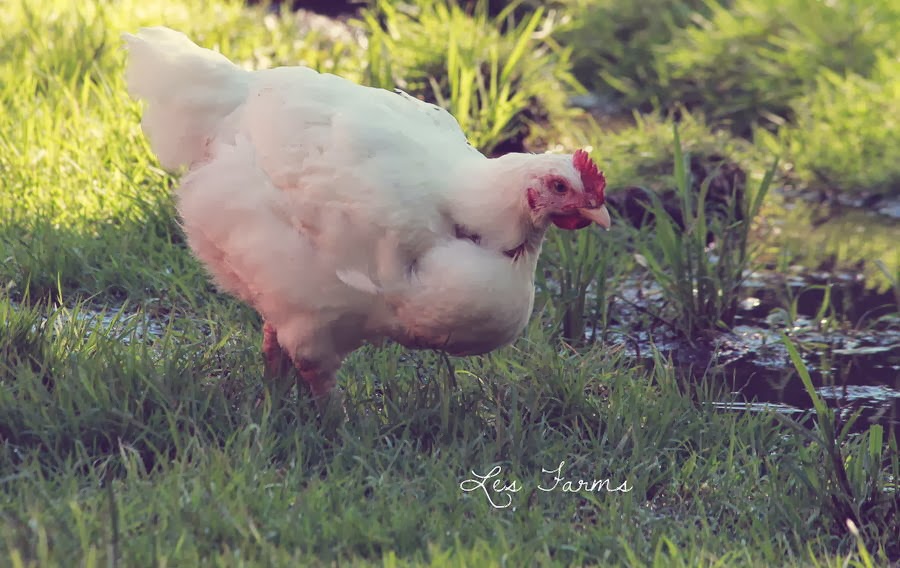
So as you can see, when the Cornish Cross is kept in a healthy, natural setting where it is allowed to free range daily, the health issues we so often hear about are practically nonexistent. The birds kept in industrial settings create an amazingly stark contrast to the picture Justine has painted – The birds that generally end up in large supermarkets live their lives in crowded broiler houses where the only exercise they get is moving from the food to the water. They don’t have access to sunlight or fresh greens, and their health suffers for it.


Please see Justine's original post HERE.
 *