Senin, 23 September 2013

The Chicken Swap Meet

By Leigh -

A chicken swap is basically a gathering of people at a predetermined location for the purpose of buying, selling and trading poultry, small farm animals, crafts and farm supplies. Many Tractor Supply Company stores around the US host chicken swaps regularly, and many other feed and farm supply stores might be interested in hosting swaps if you will set it up and spread the word.

Many monthly swaps are smaller with 10 - 20 sellers and any number of buyers. Of course size will also depend on how well the word has gotten out, the weather forecast and how many chicken enthusiasts are in the area. Often you can find out about area swaps on popular chicken forums or at your local feed stores.

Here in Virginia we have monthly local chicken swaps, but twice a year hundreds flock to Gilman's Farm & Feed Store in Glen Allen, VA (just outside of Richmond).  


And what can one find at the Gilmanor swap?

 Guinea pigs & rabbits.

 Older farmers shopping for homemade canned items while kissing baby goats wrapped in blankets.

 Thanksgiving dinner.

 Delicious snacks.
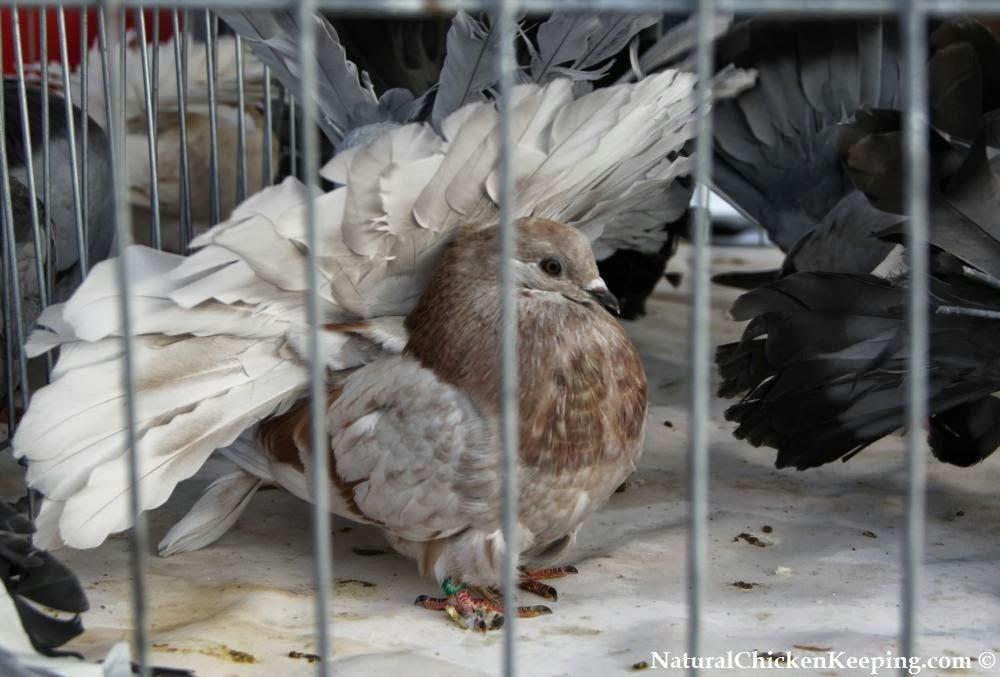
 Interesting breeds of pigeons masquerading as decorative Asian fans.

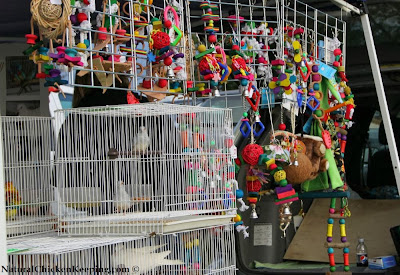
 Bird toys.

 Brilliant pheasants.

 Bloggers.

 Chickens sticking their heads out of the tops of boxes.

  Chickens sticking their heads out of the sides of boxes.

 Peafowl.

 Waterfowl.

 Things that aren't chickens.

Well-organized sellers that must go to A LOT of swaps!

 Homing pigeons.

 Fuzzy, four-legged flock-watchers.

 Laying pullets that have been debeaked. 

And pretty much anything else one can imagine. I even saw somebody selling mixed-breed foxes.

I carpooled with my friend Karen. We got a chance to meet up with a number of old friends and wonderful people we met online, which made the day even better.

So - if you want to go sell at a chicken swap, what do you need to know and bring?
  • First, find out where and when chicken swaps are held in your area.
  • Find appropriate cages to keep your birds in while there. (Wire cages work well as people can see your birds easily without touching them.)
  • Be sure to bring food, water and a source of shade for your critters (and for yourself, too.)
  • Bowls for the food/water.
  • Bring money to make change for buyers.
  • Do NOT bring sick birds!
  • Extra cages so that you can keep any birds you purchase separated from your other birds. (New birds need to be quaranteined for at least 2 weeks prior to being added to your existing flock - unless it is a chick that has not been out of the brooder yet.)
  • A source of heat for any young chicks you bring. (I brought broody hens to keep my chicks warm.)
  • The "menu." This can be a large print out of what you have for sale with the prices, a whiteboard & marker, a bulletin board or any other means of listing your birds/prices. 
  • Hand sanitizer
  • Paper towels
  • A large fish net with a long handle to catch escaped birds.
  • Business cards (if you have them).
Chicken swaps are a great way to make a little money from your hobby, meet new people and add new birds to your own flock.

Just remember, the birds other people bring may not be as healthy as yours, so do not allow anybody to touch your birds unless they are buying them. Have them use hand sanitizer prior to handling your birds. Use caution when shopping for birds at a swap and if you are planning on buying new birds, have a quarantine area ready at home.

Lastly, have fun! If your spouse, friends and family roll their eyes when you start talking chicken, swaps are a great place to meet people who speak your language and appreciate your flock anecdotes. 

- Leigh  

If you live in or around Virginia, the Gilmanor Swap is held the  1st Saturday in May and the 3rd Saturday in September. Vendor spots are only $10.00 (subject to change at the discretion of the management). The address is:

Gilman's Farm & Feed
12187 Chewning Rd.
Glen Allen, VA 23059

*

Rabu, 18 September 2013

The Dorking - An Ancient Breed with an Uncertain Future

By Karen - 

The Dorking is an ancient breed tracing it's lineage all the way back to the Roman Empire and the birth of Christ. It was first introduced into Britain by the Romans and became a favorite of many, eventually taking the name of the region where it was most popular. Thus evolved the Dorking breed. 

The Dorking evolved as primarily a meat breed, but is also a decent layer of medium to large eggs, lays through the winter and can be an exceptionally vigilant and protective hen when broody. As a meat breed, the meat is fine textured and well flavored and has been a winner of several taste tests in recent years. The Dorking of today isn't as large as its ancestors of even 50 years ago but still retains all the finer points of the breed, so now it's up to Dorking enthusiasts to bring it back up to its ideal size.
Dorking roosters should mature near 9 pounds and hens near 7 pounds (but as I said before, many do not reach their ideal size at this time). They have a long and low structure a friend once referred to as 'barge-like'. Their legs are relatively short with the thighs hidden well up in the body feathers, have five toes and white skin. They are fairly slow growing with roosters reaching their full size by 2 years old. Hens typically start laying between 5 and 6 months old.
Unfortunately, with the advent of the commercial broilers (of which the Dorking is one of the original ancestors) and the American preference for yellow skin, the slow growing Dorking fell out of favor. Since then it seems that "Bigger, Better, Faster, More" applied to peoples' lives more and more as the years went on. A few dedicated breeders continued on with the Dorking, but their population and size decreased with their popularity.  


In recent years, with the resurgence of "Heritage" breeds, the Dorking is slowly regaining some of it's popularity. In my opinion there is no equal to the Dorking, whether it be for the gourmet table bird or the all-round usefulness as a dual-purpose egg and meat breed or as an exceptional free range bird or broody for rearing chicks.

The APA recognizes 6 varieties; (single combed) Silver Grey, Colored, Red and Single as well as Rose Combed Cuckoo and Rose Combed White. A large part of the problem with Dorkings is that there are so few sources of quality birds.
The primary sources people get their birds from are hatcheries. Murray McMurray is currently probably one of the best sources for Silver Grey Dorkings. Sandhill Preservation Center has the best readily available Red and Colored Dorkings I've seen, though if you are willing to wait and hunt around, the Roger Tice and Dick Horstman lines of Reds are my personal preference. Cuckoos are few and far between, so I have no frame of reference for them at all. The Whites, however, are best gotten from Yellow House Farm. YHF is not a dedicated hatchery, but a farm dedicated to preserving and improving a few select breeds. His White Dorkings are exceptional, in my opinion.

Now on to my own birds...

I have a small flock of Dorkings, compared to some. For the silver greys, I will be keeping my six largest hens and two best roosters for breeding. I have four red hens I am keeping, but I am short a rooster at this time, thanks to a series of attacks by predators. I have one red cockerel in the grow-out pen but he's only 7 weeks old as I write this article, and I have no way of knowing how he will mature. 


I will also be contacting the breeder that two of my girls and my previous rooster came from to see if he has anything available. So hopefully in a few weeks we will be back up and running with the reds. I also have two colored girls who have no mates to match, but will be put with a red rooster at some point, to see if I can rebuild a nice colored flock. But that is a project for later.

Some people have asked me to also write about things not usually touched on for various breeds...

One of the biggest things I have noticed with my Dorkings, is their dislike of confinement and crowding. Most of my birds free range except when they are penned for breeding. As a free range bird, they are exceptional foragers and the roosters are extremely vigilant in finding choice goodies for the girls, warning of dangers and even protecting them from attack. One rooster even took on a hawk to protect his girls, losing part of his comb in the process. I think that is why I no longer have a red rooster as well. He probably died defending his girls from the raccoons. Of that, I will never know for sure though.


Hens can be exceptionally (annoyingly) broody and like their privacy. So if free ranging at the time, they will try to find secluded nests 'off the beaten path'. I've had to relocate a number of these "wild broodies" this year. Only two girls were successful in hatching their clutches. One had her nest under the ground-level deck (beneath the welcome mat) and the other next to the tractor shed. I allowed these two to stay where they were, simply because of difficulty in getting to them to remove the eggs.


Some things I can say with certainty of my own Dorkings. They do not like being confined, but will tolerate it as long as they are not crowded and are provided ample roosting space in the pen as well as the coop. I also noticed they did not generally care for the shorter pens I use for my bantams, as they like to roost off the ground even during the day. 

They are not strong fliers, only able to fly (while flapping as hard as they can) about 20' from a roost 5' high. But they ARE exceptional jumpers, capable of launching to a perch well over 6 feet up!  So when planning pens for them, I highly recommend covering them.

So I will end now with a hope that some may decide to add this wonderful breed to their efforts.

Note: My birds were free ranging at the time the photos were taken and there may be some other breeds present.


~ Karen ~

*

Minggu, 15 September 2013

Do You Speak Chicken? Flock Social Behavior and How Chickens Communicate

By Leigh - 

OK - so I'm not exactly the Rosetta Stone of the chicken world, but I think most people who keep poultry in a natural setting soon see for themselves that chickens communicate with each other. While much of their language is nonverbal, chickens do use a wide variety of vocalizations also.

So, what do chickens talk about?

The Flock:
We've all heard and witnessed flock pecking order. Every flock develops their own hierarchy within days of being put together in a coop, run or free range environment. This hierarchy also changes as new birds are added or removed from the flock. 


Flock status is developed through both verbal and nonverbal communications. Birds working to establish themselves as being of a higher rank than another bird will growl, screech, peck and jump at other birds. This behavior will continue until one bird relents and submits to the other bird by running away. This can often be seen at roosting time when older birds refuse to allow younger or birds of lower status on the same roost. (For this reason, multiple roosts are helpful in larger flocks.)

Chickens do develop lasting relationships with each other. It is very common to have various sets of BFFs within the flock. In fact, if something bad happens to one of the partners in this kind of friendship relationship, the other bird will often behave in an 'off' manner for some time following it's friend's disappearance. The remaining bird may search the yard daily or refuse to leave the spot it last saw its friend. Interestingly in cases where one friend has been isolated due to an injury and then reintroduced to the flock, the bird's friendship partner will usually instantly recognize it and the bond will resume right away.

Cockerels and roosters will spar with each other to decide who will be the dominant rooster in the flock. In most cases no blood is drawn and the argument will end when one rooster runs away. Many roosters can happily coexist in a free ranged flock provided there is a rooster to hen ratio of at least 3 hens to every 1 rooster. (More hens per roo is better.)


A flock's pecking order becomes very obvious at feeding time. The top hens will eat first, chasing off the lower-ranked and younger birds. Only when the top hens have eaten their fill will the lower-ranked birds be allowed to eat. Usually roosters will eat last, but it is not uncommon for a head rooster to eat before younger cockerels are allowed to dine.

If any of the flock witness a potential danger, they may take up a group cacophony danger call. I can only guess that this particular call is meant to frighten off predators. It is very similar to the Egg Song (more on the egg song later) and starts with a loud, frightened "buk-buk-buk-buk BAGAWK!" The end part of the call goes up not only in volume but in tone. A story - last winter my family went to visit a farm with Silkies that were kept in a barn. One of us sneezed and we were instantly almost deafened by this warning call as it was taken up by perhaps 200 Silkies all at once! If I were a domestic cat or small dog, I might think twice about getting any closer.

Of course there are times that blood will be drawn by hens or roosters alike. The roosters of some breeds are more aggressive than others and these birds may continue a fight after another rooster has backed down. Research your breeds and observe the interactions between roosters regularly to make sure you don't have problems like this in your yard.


It's also not uncommon to hear of someone who has a hen that is being picked on by flock mates to the point of being bald and bloody. While it is normal to have some pecking and disagreements among flock members, it is rare to see this kind of abuse within a free ranged flock. Free ranged birds can stay away from a nemesis throughout the day. Picking and bullying is most often seen in flocks that are kept in a coop or run for most or all of the day. It can be a sign of boredom, not enough meat protein in the diet or over-crowding. Feeding plenty of meat protein each week and placing stumps, toys and a variety of perches in the run can help, but in the most severe cases either the main abuser or the main victim should be removed from the flock. If the problems continue, it is time to assess the amount of coop and run space your birds have. Check out our article on space requirements here:  


Rooster to Hen Communications:

(A rooster calls his flock over to a treat.)

If you have both hens and roosters, chances are you have witnessed your rooster vocally calling his hens over to share a special treat he has found. When a rooster locates a particularly juicy bug or super yummy plant, he will make an excited, low clucking sound that the hens recognize as a signal to come over and look. This behavior has two purposes. First, the rooster helps to insure his hens are getting proper nutrition. Second, once the rooster gains the trust of his hens, it becomes easier for him to mount and breed them.


The mating communication is primarily nonverbal. The rooster will drop a wing and spread it out to signal he wants to mate. He will do a rather funny looking shuffle-dance with his feet as he displays his roosterish plumage. Generally the hen will squat at this time, but if she does not want to accept his amorous advances, she may screech or cluck loudly and run away. The sound an unwilling hen makes is often recognizable to the human ear as being distressed or angry.
Learn more about the chicken mating rituals here: 
How Do Chickens "Do It?" Chicken Sex Explained

Roosters are very serious about their job of keeping their flock safe. While hens and chicks roam the yard searching for treats, a rooster will keep his eyes open for danger throughout the day. If he spots anything that looks dangerous, he will make a loud, low growling or screeching sound to warn the rest of the flock. At his sound, the rest of the flock will freeze and look for the source of the danger and then run for cover. Ironically, flock members quickly learn to ignore the warnings of certain young cockerels that alarm over everything from a lizard to a falling leaf. Yes - the hens know which roosters to listen to and which to ignore just by the sound of their voice.


Lastly, roosters will quietly "talk" to their flock at roosting time. If you are quiet, you can hear the vocal exchange going on in the coop at dusk as the chickens are getting settled for the night. The rooster will make low, gentle clucking sounds as will many of the hens.


Hen to Chick Communication:


There are few things more enjoyable to watch than a hen with her brood of chicks! 

Like roosters, hens have a variety of calls to guide their chicks. For chickens it seems that language starts even before hatch. Once a chick internally pips (breaks through the internal membrane of the egg and begins breathing air) it can be heard peeping inside the shell. The mother bird hears this and will coo and cluck to her babies as they hatch. Prior to hearing this peeping, the broody hen is generally completely quiet. The only exception to the quiet broody rule is that many hens will growl rather ferociously if their nest is approached.


(Get the %&$# away from my eggs!)

Most of my own hens will start free ranging with their chicks by the second day post-hatch. She will cluck almost continuously as they explore, and the chicks will peep back the entire time. By doing this, they all keep track of each other.

When mom finds something edible, she will cluck excitedly as she picks up and drops the object over and over again until one of the chicks gathers the courage to try it. Within a few days, the chicks have learned to trust their mother's judgement and will quickly gobble up anything she offers. 


Hens alert their chicks to possible danger with a low growling sound. When the chicks hear this, they instinctively know to take cover under mom. If the mother determines there is an actual danger, she also uses body language to warn off a predator... or even just other chickens. For the first few weeks, she will do what she can to keep her flock mates far away from her babies!


(A broody hen will take on the 'Turkey' stance to make herself look larger and more threatening.)
(Below - the same hen... in a more relaxed stance.)

Chicks learn by watching their mother or other chicks. If you have chicks in a brooder, you can teach them to try new foods or use a different waterer by clucking like a mother hen with a quick "buk, buk, buk, buk..." and tapping the new treat or object with one finger. Day-old chicks will race right over to see what you are showing them. If one learns to eat something new or drink from a different kind of waterer, it will only be a matter of hours before the rest of the chicks pick up the behavior from the first one. (Cool, huh?) 

The Egg Song:
The egg song is very similar to the flock warning call: "buk-buk-buk-buk BAGAWK!" The subtle difference is the tone that is used. It can be very hard to tell the two apart, but once a person has become very familiar with their flock, they might be able to liken the warning call to a frightened crowd of people and the egg song to a joyous celebration. Hens seem to want everyone to know of their success in creating the most wonderful egg of all time (every day) and others will often take up the celebratory cry also.

In my own flock I have a few that have very average egg songs, one who clearly has the spirit of an opera singer trapped within her, and one who sounds a tad like Bruce Springsteen. Yes - they are all quite individual in their calls.

Battery Hens & Meat Birds in Industrial Settings

Studies of hens or meat birds that have been brought out of an industrial-type setting have proven quite fascinating! It is common practice for battery hens to be debeaked (the tip of the beak is literally removed) because in these crowded conditions it is common for the birds to pick on or even cannibalize one another. Social interactions of these birds are limited to the 2-3 other birds stuffed into the same small cage. There is rarely natural sunlight in these settings, no dust for bathing, no grass in which to hunt bugs in... only the wire of a cage floor.


Even in so-called "free range" settings, the industry does not provide a good environment for relationships to develop between chickens. I mean, seriously - if you were in a warehouse packed wall-to-wall with other people, you might make a friend, but it would be difficult to find them ever again in the throng.

The noise in these settings is almost deafening so it would be nearly impossible for the chickens to communicate well with each other. They don't have a choice as to who they spend their time with or what they spend their time doing.


As a result of these conditions, it has been observed that the chickens seem to lack personality. Instead of a sharp, inquisitive expression, the birds usually look dull and uninterested. Many can not even walk properly if liberated from these cage-filled warehouses. (Google "battery hens" and click on the images... if you dare.)

Yet - once liberated (should they be so lucky) instinct kicks in. The birds will observe other birds and start scratching, digging, sunning themselves and dust bathing within hours. Vocal and nonverbal communications between these birds is delayed at first. They often don't make the same sounds as chickens raised in a healthy, natural setting, but with time they do learn to communicate.

And just how smart are chickens? Well - studies suggest they are as clever as a toddler and learn new things quickly, given the right incentive. Need proof? YouTube is full of videos of people training chickens. Click HERE for a listing.

So - if you have read this entire article, give yourself credit for passing Chicken-Speak 101!

~ Leigh ~ 

Leave a comment and tell us what kind of chicken talk have you witnessed in your own flock!

*

Kamis, 12 September 2013

Mel's Magnificent Mansion... For Chickens!


By Mel -

I have been accused of "overbuilding" most of my life. I think I might have, this time, too. However... I know we have weasels here. I've seen one. We also have a chipmunk metropolis. Chipmunks will tunnel into the coop/run to get at the food and that creates a weasel "highway." I was determined that would not happen to my hens, so I literally "wrapped" the thing with 1/2-inch hardware cloth.

I was able to save my income tax refunds and I found a sawmill nearby that sells rough cut hemlock lumber, so I was able to afford to build the way I wanted to. This is NOT a "you should do this" article! This is a "I did this" article--do what you can/want with what you've got!

I designed it myself with a consultation from a guy who goes to my church and was in construction. I wanted to be sure what I was thinking would actually hold up through our typical snow fall. I am almost 60. My fellow construction worker just turned 57. Except for two men, who helped us about get the (unbelievably heavy) rafters up, Jennifer and I built this ourselves. It took more than 80 hours (how much more... I really don't want to know) all in weekends and an odd day here or there.

It is 10 feet wide by 20 feet long. The roof is a "shed roof" and is 8 feet at its height, sloping to 6 feet. The coop end is 6x10 feet, so the run is 14’ x 10’. There is gravel under the hardware cloth and over it is soil and deep litter of oak, maple, & birch leaves and pine needles. The roof is metal.

1/2-inch hardware cloth laid out. Long and wide enough to go all the way up the walls as well as the whole floor.

Pieces overlapped and ferruled together.

 4x4 rough cut hemlock foundation.

North wall going up. Jennifer screwing the wall to the foundation.

North and South walls up. This stuff is incredibly heavy! You have to work with it pretty green, because when it dries it is like iron.


Rafters up, South hardware cloth up--even where there will be coop siding. (Taking no chances.)

Coop siding up, all stained, roof on. This is the back/north side. There are no windows, but all along the eaves is open. Should be great ventilation but no drafts on the chickens, even in mid-winter. I plan on putting up a tarp along the run part, to block snow blowing in too much.

Gravel on top of hardware cloth, beginning to put in the loam.

Inside the coop part. Found a gallon of buttercream yellow “oops” paint at Home Depot for $6.00. Easier than mixing white wash…and cheaper. I tried to replicate my friend Sue's “log stair steps instead of a ramp” idea.

Run end looking out from coop. Little box on left is a greens growing bed, with wire on top, to keep them from scratching the plants totally out.

Eaves. Even if they climb very well, the weasels (and ‘possums, and raccoons) will be thwarted.

All done. Windows are just rectangles cut in the siding…the hardware cloth is already there. I figured out and built and hung the dutch door all by myself.

- Mel 

*