Tampilkan postingan dengan label Karen. Tampilkan semua postingan

Rabu, 18 September 2013

The Dorking - An Ancient Breed with an Uncertain Future

By Karen - 

The Dorking is an ancient breed tracing it's lineage all the way back to the Roman Empire and the birth of Christ. It was first introduced into Britain by the Romans and became a favorite of many, eventually taking the name of the region where it was most popular. Thus evolved the Dorking breed. 

The Dorking evolved as primarily a meat breed, but is also a decent layer of medium to large eggs, lays through the winter and can be an exceptionally vigilant and protective hen when broody. As a meat breed, the meat is fine textured and well flavored and has been a winner of several taste tests in recent years. The Dorking of today isn't as large as its ancestors of even 50 years ago but still retains all the finer points of the breed, so now it's up to Dorking enthusiasts to bring it back up to its ideal size.
Dorking roosters should mature near 9 pounds and hens near 7 pounds (but as I said before, many do not reach their ideal size at this time). They have a long and low structure a friend once referred to as 'barge-like'. Their legs are relatively short with the thighs hidden well up in the body feathers, have five toes and white skin. They are fairly slow growing with roosters reaching their full size by 2 years old. Hens typically start laying between 5 and 6 months old.
Unfortunately, with the advent of the commercial broilers (of which the Dorking is one of the original ancestors) and the American preference for yellow skin, the slow growing Dorking fell out of favor. Since then it seems that "Bigger, Better, Faster, More" applied to peoples' lives more and more as the years went on. A few dedicated breeders continued on with the Dorking, but their population and size decreased with their popularity.  


In recent years, with the resurgence of "Heritage" breeds, the Dorking is slowly regaining some of it's popularity. In my opinion there is no equal to the Dorking, whether it be for the gourmet table bird or the all-round usefulness as a dual-purpose egg and meat breed or as an exceptional free range bird or broody for rearing chicks.

The APA recognizes 6 varieties; (single combed) Silver Grey, Colored, Red and Single as well as Rose Combed Cuckoo and Rose Combed White. A large part of the problem with Dorkings is that there are so few sources of quality birds.
The primary sources people get their birds from are hatcheries. Murray McMurray is currently probably one of the best sources for Silver Grey Dorkings. Sandhill Preservation Center has the best readily available Red and Colored Dorkings I've seen, though if you are willing to wait and hunt around, the Roger Tice and Dick Horstman lines of Reds are my personal preference. Cuckoos are few and far between, so I have no frame of reference for them at all. The Whites, however, are best gotten from Yellow House Farm. YHF is not a dedicated hatchery, but a farm dedicated to preserving and improving a few select breeds. His White Dorkings are exceptional, in my opinion.

Now on to my own birds...

I have a small flock of Dorkings, compared to some. For the silver greys, I will be keeping my six largest hens and two best roosters for breeding. I have four red hens I am keeping, but I am short a rooster at this time, thanks to a series of attacks by predators. I have one red cockerel in the grow-out pen but he's only 7 weeks old as I write this article, and I have no way of knowing how he will mature. 


I will also be contacting the breeder that two of my girls and my previous rooster came from to see if he has anything available. So hopefully in a few weeks we will be back up and running with the reds. I also have two colored girls who have no mates to match, but will be put with a red rooster at some point, to see if I can rebuild a nice colored flock. But that is a project for later.

Some people have asked me to also write about things not usually touched on for various breeds...

One of the biggest things I have noticed with my Dorkings, is their dislike of confinement and crowding. Most of my birds free range except when they are penned for breeding. As a free range bird, they are exceptional foragers and the roosters are extremely vigilant in finding choice goodies for the girls, warning of dangers and even protecting them from attack. One rooster even took on a hawk to protect his girls, losing part of his comb in the process. I think that is why I no longer have a red rooster as well. He probably died defending his girls from the raccoons. Of that, I will never know for sure though.


Hens can be exceptionally (annoyingly) broody and like their privacy. So if free ranging at the time, they will try to find secluded nests 'off the beaten path'. I've had to relocate a number of these "wild broodies" this year. Only two girls were successful in hatching their clutches. One had her nest under the ground-level deck (beneath the welcome mat) and the other next to the tractor shed. I allowed these two to stay where they were, simply because of difficulty in getting to them to remove the eggs.


Some things I can say with certainty of my own Dorkings. They do not like being confined, but will tolerate it as long as they are not crowded and are provided ample roosting space in the pen as well as the coop. I also noticed they did not generally care for the shorter pens I use for my bantams, as they like to roost off the ground even during the day. 

They are not strong fliers, only able to fly (while flapping as hard as they can) about 20' from a roost 5' high. But they ARE exceptional jumpers, capable of launching to a perch well over 6 feet up!  So when planning pens for them, I highly recommend covering them.

So I will end now with a hope that some may decide to add this wonderful breed to their efforts.

Note: My birds were free ranging at the time the photos were taken and there may be some other breeds present.


~ Karen ~

*

Jumat, 23 Agustus 2013

Blue Laced Red Wyandottes

By Karen -

I posted this previously on BYC, but feel it may need to be reviewed again...

I've seen so many questions about peoples' birds, pics, etc...

First, as far as color is concerned, blue laced red Wyandottes are just that...  they are blue (but can also be black or splash, since blue does not breed true), they are laced (a complete NARROW band of blue/black/splash around the center color), and they are RED.  In this case, red is not just your 'run of the mill' red like you'd see in a black breasted red whatever, but the deep dark mahogany red seen in the old heritage type Rhode Island Reds... 

This breed has no place for anything resembling gold, copper or fire-engine red. There is also no place for poor or incomplete lacing, and birds that have wide lacing will not breed true either. Over all, the blue is the easiest part to get right on this breed. It is also the most insignificant aspect of what makes a bird a BLRW.

And honestly, getting the color right is by far the easiest part of breeding GOOD blrw... it's the type that seems to be lacking 9 times out of 10, IMO...  Or just flat out ignored in some cases, I think.  But without type, all you have is a pretty chicken. NOT a Wyandotte.
So here's a brief refresher from past discussions regarding Wyandotte type...

One of the most commonly misunderstood (or even flat out ignored) is the proper profile a Wyandotte should have.

The following is from an old text regarding the Wyandotte standards...  useful for seeing right and wrong as far as overall body shape (ie, type)


the genetics behind lacing (good and bad):

Pg is the pattern gene, Ml is the melanizing gene, Co is the Columbian gene. Each one is dominant over the wild type (shown with a +). If all 3 mutations are not homozygous (2 copies of the mutation present) then the appearance of the lacing is changed.

the black tip mentioned above - AKA spangling  - can be seen in the image below, including proper and improper feather markings in a laced bird.

I hope this helps clear up some of the 'mystery' behind a beautiful variety and breed.
Here are my two large fowl birds, the others were killed by predators recently. I'm hoping to start hatching again once the hen is done being broody. The last picture is my bantam BLRW rooster. I'm searching for a better hen to use with him, as she appears to be more of a partridge than laced.  None of these birds are perfect, but were the best I could find and afford when I started breeding this variety. I lost one unrelated hen (black laced bred by J. Foley) and a black laced red pullet that was maturing very nicely from this breeding pen.
blue laced rooster (LF)
 splash laced hen (LF)
blue laced bantam rooster


Selasa, 29 Januari 2013

Blue Genes? Chicken Genetics Made (almost) Simple

By: Karen - KI4GOT   (Visit Karen’s Farm Here)

 
Chicken genetics seem to be an endless source of confusion for so many people. I've taken a number of genetics courses in college, and at first they even confused me, but I also didn't know much about what the various mutations looked like in comparison to a number of different breeds. When I first started keeping chickens again, I had no idea where to start in determining what mutations were involved in some of the varieties I had.

Since then, I've done more research into specific colorations found in certain breeds, such as Bantam Cochins and Dorkings, and have gained a greater understanding of what goes into each variety. It also doesn't help that the same color in one breed may be called something else entirely in another. For example, comparing Brahma's to Cochins, a Light Brahma is also known as Columbian in the Cochins, while a Dark Brahma is known as Silver Penciled in the Cochins. Silver Grey dorkings are known as Silver Duckwing in many varieties, Red Dorkings are also called Black Breasted Red (aka BBR), or Red Duckwing in other breeds.

Before I start, let me mention that I tend to refer to mutations as having 1 or 2 copies of the gene, while the description below mentions each gene having 2 alleles. This is just 2 ways of saying the same thing. Here's a brief review of what DNA is.


Living things are made of millions of tiny self-contained components called cells. Inside of each cell are long and complex molecules called DNA. DNA stores information that tells the cells how to create that living thing. Parts of this information that tell how to make one small part or characteristic of the living thing – red hair, or blue eyes, or a tendency to be tall – are known as genes.

Every cell in the same living thing has the same DNA, but only some of it is used in each cell. For instance, some genes that tell how to make parts of the liver are switched off in the brain. What genes are used can also change over time. For instance, a lot of genes are used by a child early in pregnancy that are not used later.

A living thing has two copies of each gene, one from its mother, and one from its father. There can be multiple types of each gene, which give different instructions: one version might cause a person to have blue eyes, another might cause them to have brown. These different versions are known as alleles of the gene.

Since a living thing has two copies of each gene, it can have two different alleles of it at the same time. Often, one allele will be dominant, meaning that the living thing looks and acts as if it had only that one allele. The unexpressed allele is called recessive. In other cases, you end up with something in between the two possibilities. In that case, the two alleles are called co-dominant or incompletely dominant.

There are two types of mutations. Autosomal and Sex-linked. All the mutations known in chickens are autosomal, with the exception, for all mammals and birds, of one pair of sex-determining genes. In people, men are shown as X/Y, while women are X/X. In poultry, the hen is designated as X/- while the rooster would be X/X. Each parent donates 1 allele from each gene in the DNA strand. Only the X chromosome carries genetic information, the /Y or /- sex determining chromosome does not carry any other information.

There are so many mutations and so many breeds, it can be overwhelming to say the least. It also doesn't help that a number of mutations react differently when combined with others. What I'd like to do here is to explain the basic functions of some types of mutations...

**NOTE: When you see a mutation abbreviation with + next to it, that refers to the normal or wild type gene that is not affected by any mutation. Essentially, a Black Breasted Red is unaffected by any mutations at all. It is the coloration found in the original Jungle Fowl that chickens descended from. Mutations shown capitalized are considered dominant, while lower case letters are recessive. Sometimes there are multiple mutations found on the same gene, and even though several might be recessive, there is a dominance of one over another.

Recessive mutations always require 2 copies of the gene (aka matching alleles) to be visible, while dominant mutations only require 1 copy to be present for the mutation to be apparent. There are also dominant mutations that are known as 'incompletely dominant', where only 1 copy of the gene gives you one visual type while 2 copies gives you another.

The mutations known to chickens typically do one of three things. They affect pattern, red pigmentation (known as pheomelanin) and black pigmentation (known as eumelanin). The pattern genes can be some of the most confusing, so I will leave that for last. Some mutations affect roosters and hens differently.


Kippenjungle's Chicken Calculator is a handy tool for anyone wanting to learn how genes interact with each other. All pictures (other than photos) below are from there and show only the single gene effect on an otherwise wild type bird. Another note - although the images are basically the same for some mutations, there are slight differences when shown on a live bird. These images are just to give you the basic idea of what it does.
 
For the most part, pheomelanin and eumelanin are affected in one of 2 ways. They are either enhanced (made darker) or restricted (made lighter).

These mutations are:

· Mahogany (Mh) - dominant, enhances red but limits some black.
       
· Dilute (Di) - dominant, dilutes red and gold pigments.
· Champagne Blond (Cb) - dominant, dilutes gold pigments.
· Inhibitor of Gold (ig) - recessive, changes gold pigments to yellow (lemon).
· Silver (S) - sex-linked incompletely dominant, turns red to white in roosters and turns brown to grey and lightens the salmon breast (when present) in hens.
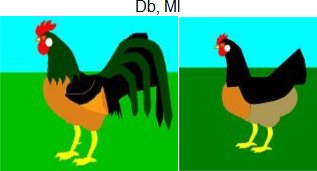
· Dark Brown (Db) - refers to color of chick down. Columbian-like restrictor of black. Less effective on hens. Reacts with other mutations to cause some patterns and acts under Birchen.
· Melanotic (Ml) - dominant, enhances black pigments. Also shifts black pigment helping form patterns in the presence of other genes.
· Charcoal (cha) - recessive black enhancer.
· Chocolate (choc) - sex-linked recessive, dilutes black pattern to chocolate color.
· Dominant White (I) - dilutes black patterns to white (sometimes leaky).
· Dun (Id) - incomplete dominant. 1 copy dilutes black to brown, 2 copies dilute further to khaki.
· Smokey (is) - recessive blue. changes the effects of dominant white to a blue color. recessive to wild type i+
· Blue (Bl) - incompletely dominant, 1 copy dilutes black to blue/grey, 2 copies dilute further to splash.
· Recessive White (c) - no expression of any color, thus white feathers.
· Lavender (lav) - recessive, dilutes black to lavender, dilutes gold to isabell. The American Poultry Association (APA) refers to the lavender color as "Self Blue".
Pattern genes are complex and often confusing. They may simply change the coloration of each feather, only certain areas of a bird or even areas only on a single sex. Quite often they also respond differently in the presence of other restricting or enhancing mutations listed above.

The e-locus mutations are sometimes the hardest to understand, since many affect each sex differently. They may also modify (or be modified by) other genes present.

· Wild Type (e+) - Males black breasted with red duckwing (wing triangle), hackle, saddle, shoulders. Females brown-gold with salmon breast, black stippling on back and black tail.
· Extended Black (E) - Dominant, turns the wing triangle black, changing it from a duckwing to a crow-wing. Males become a rusty black, hens less rusty black.
· Birchen (ER) - Turns wing triangle black (crow-wing) but leaves hackle and saddles normally marked. Black breast can be laced. Somewhat flattens red tints.
· Wheaten (eWh) - Least permissive for black, most permissive for red. Males are wild type without hackle black, females wheaten colored without salmon breast and almost no stippling on back.
· Partridge (eb) - Males are wildtype but somewhat heavier black striping in hackle. Hens are wildtype but without salmon breast. (Not to be confused with the color Partridge, in which hens are double laced)
The mutations affecting feather patterns are probably the easiest to understand (at least for me).

· Columbian (Co) - restricts black from the body of both males and females, also suppressing the salmon breast in hens. leaving the hackle pattern and black tails. Does not have any effect on ER (birchen) birds.
· Pattern gene (Pg) - changes the black pigment in hens to concentric penciling, males remaining unchanged except in the presence of certain other genes.
· Barred (B) - sex-linked dominant. produces alternating bars of black and white pigment. Males with 2 copies of the gene will appear lighter and the barring finer and more distinct, where males with only 1 copy will resemble females with wider and less distinct barring (sometimes darker overall coloration).
· Mottled (mo) - recessive, giving white feather tips or less regular white patches.
When you start combining certain mutations you can get some drastic differences from what you might expect, and some different combinations produce nearly the same result.

· Co, Pg, Ml - single lacing
· Co, Ml - quail-type pattern, columbian with patterned back

· Pg, Ml - double laced
· Db, Pg, Ml - spangling
· Db, Pg - autosomal barring (quilt pattern)
· Co, Db, Pg, Ml - single lacing (sometimes half moon spangling) with patterned tail
· Co, Db, Ml - quail-type pattern, columbian with patterned back
· Db, Ml - quail-type pattern, columbian with patterned back
· Co, Pg - incomplete single lacing

I should also mention though, all of the talk of colors has NOTHING to do with breed requirements in regards to type or conformation. For more information on specific breed requirements I recommend purchasing the APA Standard of Perfection, available directly from the APA at http://www.amerpoultryassn.com/store.htm

Here are a few other examples of a few patterns and combinations, including some not mentioned above, that you might find when dealing with laced varieties.
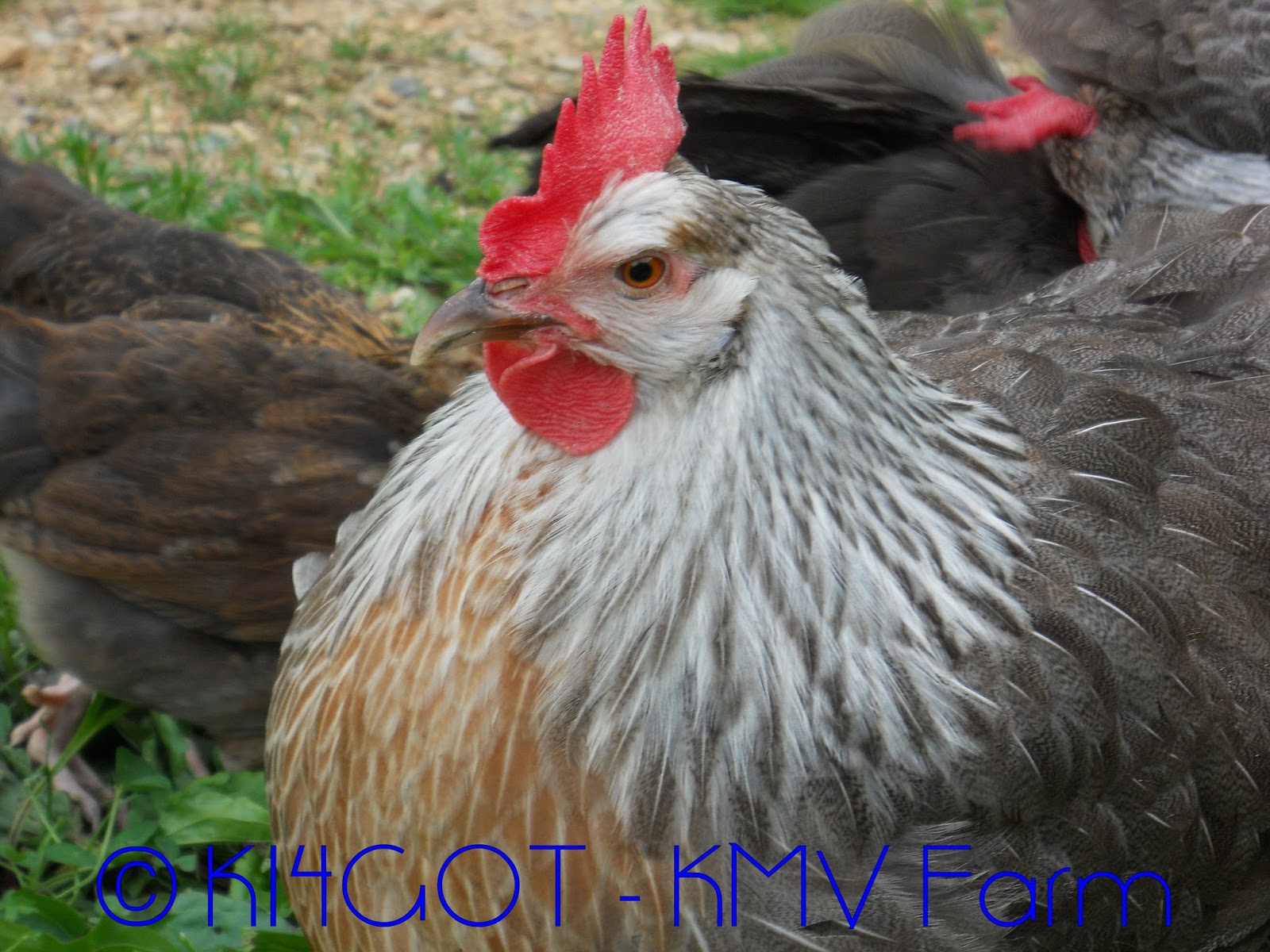
Also included are a few pictures of REAL birds, to give an idea of some of the colors listed above...
   
Leigh's Blue and Splash Swedish Flower Hens. These birds have the blue gene (Bl/bl on the left, Bl/Bl on the right), in addition to mottling (Mo) and columbian (Co) that give the typical calico/mille fleur pattern.

   
My own blue laced red bantam Wyandotte rooster and a splash laced red Wyandotte (LF) pullet. The mutations involved in these birds involves the pattern gene (Pg), melanizing (Ml) and columbian (Co) which give the classic lacing, plus blue (Bl/bl for the roo & Bl/Bl for the hen) and Mahogany (Mh) to deepen the intensity of the red.

This next pair are both Red Dorkings, essentially the wild type of chickens, having no mutations at all.

     
The three birds in the foreground are silver grey Dorkings (two hens on the left, rooster on the right). The only mutation involved in these birds is silver (S). To the right (chopped off a bit) and also the picture below are two dilute red Dorkings. I'm not positive of the exact genome, but these two girls have dilute (Di) and the one below may possibly also have mahogany (Mh), which would explain the darker red head and breast than the one above.

Karen